Recently, I noticed a bit of discussion regarding the Onctotype test and the types of breast cancer which are useful to evaluate with this test. I read this on the post by Hopeful, and thought it might help. It seems to reiterate what I've read on the John Hopkins site:
DR LOVE: You recently wrote an editorial in the
JCO regarding the Onco
type DX assay and the NSABP-B-20 data (Paik 2006). Can you comment on that (Swain 2006)?

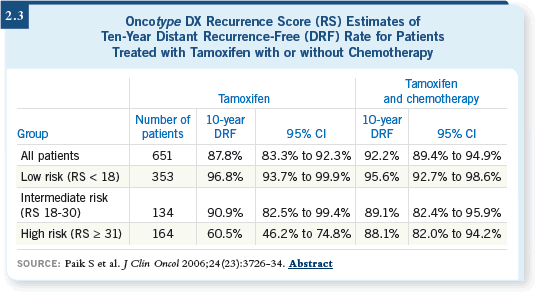
DR SWAIN: In the NSABP-B-20 study, patients with ER-positive, node-negative disease were randomly assigned to tamoxifen with or without chemotherapy.
The trial showed a benefit with the addition of chemotherapy, and when the Onco
type DX assay was performed, investigators found that patients with a high recurrence score benefited from chemotherapy, whereas those with a low or intermediate recurrence score did not (Paik 2006; [2.3]).
To me, this is an outstanding contribution. I now use Onco
type DX for all my patients who have ER-positive, HER2-negative, node-negative breast cancer, and I’ve found it to be helpful.
<map name="Map2" id="Map2"><area shape="rect" coords="274,249,358,287" href="http://www.ncbi.nlm.nih.gov/entrez/query.fcgi?db=pubmed&cmd=Retrieve&dopt=AbstractPlu s&list_uids=16720680&query_hl=17&itool=pubmed_DocS um" target="_blank"> </map>
DR LOVE: Do you rely on Onco
type DX for patients with larger tumors? For example, would you be comfortable omitting chemotherapy for a patient with node-negative disease but a 4-cm tumor if her recurrence score was low?
DR SWAIN: Absolutely. I believe that it’s all about the biology and not the size, particularly.
The other important benefit of Onco
type DX, which was presented at the San Antonio Breast Cancer Symposium, is its reliability in measuring the estrogen receptor (Kim 2006). I believe RT-PCR may be the best way to measure the estrogen receptor. We know immunohistochemistry (IHC) is fraught with problems, and I’m uncomfortable when I receive an estrogen receptor assay result from a small laboratory.
Select Publications 



 Linear Mode

