Per
Lani's post : here is one
Our data demonstrate that FOXP3 is an X-linked breast cancer suppressor gene and
an important regulator of the HER-2/ErbB2 oncogene.
Bev, Your question:
Would Foxp3 possibly explain no BC history on maternal side and unknown history on paternal side? BB
Bev, Lani may be anwer your question.
I'm not sure if FOXP3 x-linked
recessive gene or x-linked
dominate. The following explain x-linked recessive and dominate:
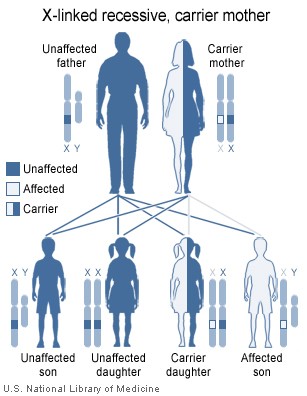
X-linked inherited diseases occur far more frequently in males because they only have one X chromosome. Females must receive a copy of the gene from both parents to have such a
recessive disease. However, they will still be carriers if they receive one copy of the gene.
Recessive genes on the X chromosome that cause serious diseases are usually passed from female carriers to their ill sons and carrier daughters. This is because males, who always have the disease and are not just carriers, would have to father a daughter to pass on the gene. This is unlikely because severe genetic diseases often cause death in childhood or early adulthood. Even those males who survive childhood are unlikely to father children because a sickly male will be less likely to find a
mate. However, if the disease shows up late in life, or is not severe, he will pass the gene to all of his daughters. He can not pass it to his sons because a male receives his X chromosome from his mother.
A mother with one copy of the gene has a 50% chance of passing it to her children of both sexes, but her daughters will just be carriers of the gene unless their father has it too.
-X-LINKED RECESSIVE CARRIER MOTHER
--------
X-linked dominant is mode of
inheritance in which a
gene on the
X chromosome is
dominant<SUP class=reference id=_ref-0>
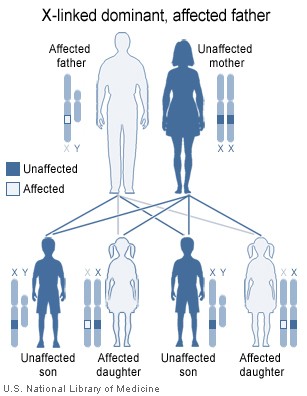
[1]</SUP>. Females can be more frequently affected than males since they have two X chromosomes that could potentially carry the abnormal gene, whereas a male has only one. However, the Lyon hypothesis states that X-inactivation renders only one copy of the X chromosome active in each cell hence on average one would expect only one half of the cells to express the abnormal gene. The chance of passing on an X-linked
dominant disorder differs between men and women.
This inheritance pattern is less common than
X-linked recessive.
X-LINKED DOMINANT - AFFECTED MOTHER
---A woman with an X-linked dominant disorder has a 50% chance of having an affected child.
 X-LINKED DOMINANT - AFFECTED FATHER
---The daughters of a man with an X-linked dominant disorder will all inherit the condition.
X-LINKED DOMINANT - AFFECTED FATHER
---The daughters of a man with an X-linked dominant disorder will all inherit the condition.
<!-- / message -->